Showing posts with label Switch. Show all posts

Jun 20, 2019

My Friend Pedro Preview


By: Logan Manfredi on Nintendo Switch
Overview
        My friend Pedro is a new game out today published by the always reliable Devolver Digital and developed by solo dev Dead Toast Entertainment. Using a Genre to label this game would be reductive. Stylistically it's that of a dark comedy you'd find on Adult Swim. From a gameplay perspective, Pedro feels more like a highly polished bullet hell or arcade classic. The controls are easy to grasp but offer a level of mastery that I can see being all over Twitch and social media. Mission ranks at the end of each level provide an easy way to challenge friends and leader boards for high scores. 
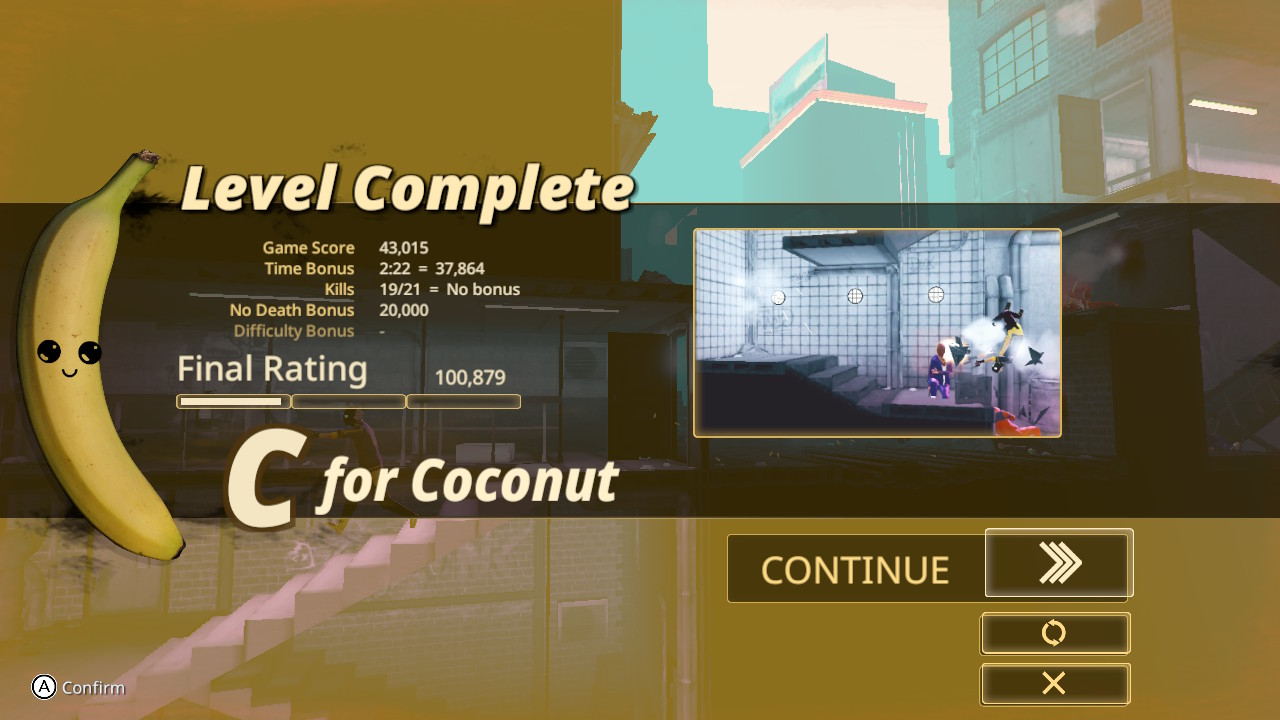
Aiming two guns simultaneously while flipping through the air has never felt this precise. Every time you start to feel comfortable with the controls, a new unique mechanic is added. Items such as kick-able balls or gas cans add yet another layer to the intricate dance that is gameplay. Something that Pedro does excellently is keeping the player on their toes. What I mean by that is, every time a new mechanic gets added, there's a certain level of uncertainty and adrenaline the player feels as they try to complete the level as fluidly as possible. The stages are shorter than I imagined but work perfectly with the design of the game. Each level focuses on typically one new mechanic to learn and then master over a few obstacles. The subsequent levels then add to those concepts in a delicately beautiful snowballing fashion. After each significant chunk of levels, there are gorgeous set pieces that feel like an entirely new game. Things like motorcycles or sky diving replace the normal side-scrolling action and propel the eccentric story forward with each one. The story itself, which I won't spoil is worth experiencing and is consistently surprising me with new and exciting ideas. 

The first few levels
        The beginning of the game will see you the player learn all the basic mechanics of the game such as Focus, Split shooting, and dodging. Focus is the game's version of a bullet time effect in which time slows down so the player can plan and score higher combos.  Personally, I've been using this to clear certain jumps or if I know there a specific path I need to follow to get an impressive looking kill sequence. Split shooting is the act of dual wielding guns and aiming them at two different targets. This is handled the best I've seen in any game in Pedro and feels incredibly natural. Using Focus to slow time and aim your split shot, you can score some crazy combos and pull off some real John Wick style moves. Dodging is simple in design but combined with the other core mechanics adds a sense of flair to the gameplay. In order to dodge the player holds a button and spins. This is interesting because the player can still shoot when spinning or even reload and the animation itself makes everything you do look that much cooler. The start of the game is a great time to explore combining each of these mechanics and find precisely how you like to play without being punished by some of the more advanced features like intense platforming sections later on. 

**Mild Spoiler alert**

Sizzle reel


Mechanics to watch out for
        I'm enjoying My Friend Pedro just as much as I thought I would and will probably finish it tonight or tomorrow. That being said, it's not without some hiccups. There were a few small things that I found not necessarily bad, but they didn't fit the way they should with the rest of the game and some caused pauses in an otherwise action-packed game.  The skateboard functions like all the other kick-able objects except for the fact that you can ride and jump with it. 

The problem is that the jump with skateboard mechanic always seems to lose the skateboard and cause me to lose my momentum. The level design where skateboards are present clearly show paths for the entire level to be done in a swift kickflipping combo of death, but the skateboard itself is just too slippery to clear most obstacles. Instead, I found myself walking around them intentionally, so I could do more badass ninja flips, and 360 wall jumps in slow motion. I worry that the rest of the game feels so incredibly good to play that skateboards may be ignored so you can continue with your bullet ninja flow. I found a few other little things that were not game breaking but kept consistently killing me until I figured out exactly what was happening. Typically, the gameplay is quite fast-paced, and bodies are flying everywhere. I kept dying and not knowing why that was until I saw that enemies would sometimes get stuck behind other dead enemies and bullets in Pedro do not pass through bodies. This would result in me pouring clips into enemies never actually hitting them. This was easy enough to address by slowing down and using Focus to get a new angle on the corpse shield using jerks. 

Overall it took nothing away from my gameplay experience, but it seemed unintentional in design. The only other thing I found to be a nuisance was that the button control for Focus is to push down the left stick and that causes my heavy fingers to unintentionally trigger Focus more often than I would like to admit.

Tips and tricks

  • You can kick enemies for a melee attack that helps extend combos when reloading.
  • The larger the combo, the bigger your score. You can extend combos by killing enemies.
  • Switch guns often, certain situations are much more suited for a specific weapon.
  • You can dodge bullets and reload at the same time.
  • Levels are short if you're playing for a high score restart the whole level when you die to get the no death bonus.
  • Pay attention to your score screen at the end for ways that you can increase your high score. 


If you like it
        My Friend Pedro is a blast to play, and for the current discounted price of $16.99 until July 9th on Steam, it's completely worth picking up. There are hours of intense adrenaline filled gunplay to be had, and the Banana named Pedro is simply the man. The wacky story filled with comedy lends perfectly to the hectic yet rewarding gameplay, and I can see perfectionists getting tons of replay value from competing for high scores on individual levels. Frequent new mechanics and wildly varying level design pull the player in and make it an incredibly hard game to put down. As far as fun is concerned the game is an 11/10 and I can't think of any game quite like it. I highly recommend giving it a try and look forward to anything more from the developer.

https://store.steampowered.com/app/557340/My_Friend_Pedro/

Jun 17, 2019

Steam World Heist Review

By Logan Manfredi
on Nintendo Switch 

Overview
        The Steamworld games from Image and Form are some of the most interesting in modern gaming. We, as players, often see sequels and game series that update graphics or add a few new mechanics, but virtually the games stay the same. While the first two games in the series Steamworld Dig 1 & 2 follow that pattern, the third installment, Steamworld Heist flips the series on its head in a completely different way, and it’s magical. The third game in the franchise takes a 180-degree turn from its Metroidvania roots and finds itself as turn-based strategy game instead. Procedurally generated tunnels are traded for spaceships in the sci-fi continuation of the Steamworld universe. Heist is unique, 2d graphics and turn-based gameplay haven’t worked this well since the SNES. The core loop of the game is boarding ships, getting loot, and evacuating, and it feels different every time. Never was I bored being a space pirate. Heist follows a crew of Steambots who until now were just trying to get by. Circumstances beyond their control force the team into a daring quest that will determine the very fate of Steambot kind. Along the way, they will meet a charming cast of characters each with unique motivations entirely their own.
The story itself is minimal in exposition, but that doesn’t take away from the connection between the player and playable characters. These connections are made possible by the detailed dialogues that take place between missions on your home ship. Each time the player returns home, the crew from the previous mission will be waiting with an optional conversation that will either reference what just happened in the story or reveal a pivotal moment in the characters past. The most shocking thing about this game for me was the length of the campaign. Typically for twenty dollars, you don’t expect games to extend past the ten or twelve-hour mark. Heist shatters this expectation with a heap of content that will take the average player close to twenty hours just to complete the story. Beyond that, the game offers tons of replayability with a four-star ranking system for each quest and a new game+ mode that allows for players to max out each character and find all of the items and weapons available in the game. For twenty dollars few games hold up to Steamworld Heist in terms of content alone.    

The Details
        Cerebral would be a kind word to describe Steamworld Heist. The game at times feels more like chess than a video game, and that’s something I was not mad about. Incredible detail in character and level design allows for rewarding combinations of character abilities that can play out over multiple turns making the player feel like a strategic genius. That being said, there are some things I found that the game could do without, but nothing significant enough to stop me from enjoying my time with it. At the end of missions, once everything has been done, players must walk around and grab loot, being that the game is turn based this takes more time than I would like. Without enemies having their turns the act of taking endless turns to move slowly towards loot and back feels quite tedious. A simple fix would be if just after completing a mission you could get all the loot still left on the ground. In all reality, there is no need for an excess four or five turns just to run around and grab loot with no risk. 
item descriptions are hilarious and worth reading.
        Another excellent detail of the game is how the playable characters progress. Typically, in a game that’s this long by the end, the characters would be in the high double digits in terms of level with numerous passive and active abilities. Where Heist stands out is with its slow and methodical leveling that makes each level-up have a drastic effect on gameplay. Every new ability changes the core strategy of said character and allows for new and exciting ways to tackle missions. The game has a little bit of a dip towards the middle portion, but new characters and the wildly varying types of missions make the end of the game feel incredibly fresh and rewarding. The specific addition of Billy, the deep space diver, drastically changes the pace and style of the game, and after about 11 hours, he was just what I needed to remain invested.  On a lighter note, the game has some enjoyable features available on the Switch. The HD rumble of the Joycons makes the joining of airlocks and recoil of firearms feel great, and the addition of full touch controls not only makes aiming much easier but allows for a certain level of comfort when playing the game. I’ve been recovering from surgery as of late and was able to complete the game almost entirely with one hand. 

My favorite thing
        My favorite thing about Heist is the abundant variance in mission structure. No two missions are the same. From size and layout to number and type of enemies, every mission is uniquely its own. On top of that, depending on what characters the player decides to take on the mission, the same exact quest could have multiple different outcomes and paths to completion. Some missions require a single character, while others could require up to four, this allows for precise leveling of certain characters and creates a wonderful sense of variety throughout the game.
Variety in crew size.
Like most players, I found myself gravitating towards a specific crew and taking the same four characters out on most missions. It wasn’t until about eleven hours in that I started to experiment with mixing up my team and the way I played the game changed completely. Each crew member has specific skills such as self-healing, increased movement range, or becoming invincible for a turn. Combing different crewmates skills allowed for wildly different strategies and helped to keep the longer than average campaign from getting stale. Typically, I spend about a week reviewing a game, but the sheer variance in playstyles of Steamworld had me solely playing it for about two weeks. Every time I thought I was at the end of the game, I was pleasantly surprised by the addition of a new crewmate, items, or even entirely new zones to explore. 
Example of cutscene 

 In the end
        Steamworld Heist is an exciting new take on an already stellar franchise. The charisma of Steamworld and its characters match that of the others in the series perfectly. Entirely new gameplay mechanics introduce fans new and old to an exciting and fresh way to play this beast of a strategy game. Variety in gameplay is where this game shines, and no two players could expect to have the same crew. While the length of the game could deter some, I highly recommend switching up your team as often as possible because it creates fun and exciting new ways to play the game and the story is worth experiencing. The game is also often on sale, and at the already budget price of $19.99 few others match it in terms of content. I recommend it for any fan of strategy games like X-com, or Divinity or to anyone looking to mix up their gaming habits. 

I give Steamworld Heist 3 and a half snails out of 5.


May 29, 2019

The Way Reviewed

By: Logan Manfredi 
on Nintendo Switch


"A beautiful journey into the unknown"


***Mild spoilers ahead, nothing major just some examples of the design***

Overview
        The Way is as much of a novel as it is a video game. There is a level of detail present within the game world that offers a sense of immersion more attune to Tolkien than Nintendo. Subtitles present in the environment offer nuanced yet critical information to the overall narrative. Much like a book, The Way is not about killing a boss or a bad guy. The game focuses on Tom, a scientist/astronaut who recently lost his wife and is unable to cope with it. This is so refreshing because it's telling a story, not just feeding a gameplay loop. Moments like a giant alien beast chasing you until you, unfortunately, have to slay it, then seeing its young pup and immediately feeling guilty for your actions give this game an exquisite sense of immersion and refreshing look at character development that makes the player more easily relate. There are multiple times in the game where the narrative, along with the mechanics, take a drastic shift and flip the story and the player's expectations on their head. After making the decision to raise the animal you orphaned and losing your gun, the game redesigns its past mechanics and further progresses the story by now having you, the player coexist with nature rather than destroy it to get what you want. This is just one example of the many times the development of the main character directly affects gameplay. Shifts like this allow for the story to have a more significant impact on the player because the consequences of the story have a direct effect on subsequent game mechanics. 

Another thing the game handles uniquely and beautifully is time. I enjoy the long stretches of time that pass in The Way because it adds to the realism and emphasizes the story that much more. It would take months or even years to decode an alien language or repair broken equipment, so the fact that the hero loses such essential time on his journey makes the player feel the same wear and weight that the quest has had on him. This connection between player and narrative is what makes this game stand out to me, and the reason I would recommend playing it. The gameplay itself is of quality and feels good, but doesn't hold up to the story in the latter half of the game. 
        Towards the end of the game, the quality of puzzles takes a sharp decline, and the player is expected to know things that only the developer could see. A large part of this I think is because the first two-thirds of the game has beautiful alien worlds and lots of contrasting colors helping puzzle elements stand out and make the player feel like they discovered the solution on their own. 
In the third act, each "generator" is a colorless pit that hides things like ladders and switches by being too dark and using an only grey color pallet.
Dark levels drove me mad.
Puzzles before were fun and trial and error would reveal the solution eventually. Later in act 3, puzzles expect players to know or remember long detailed sequences that are hidden in a shadow on the wall or not even mentioned period. Every room in act three feels exceedingly similar, and players are not introduced to a new puzzle mechanic for hours, rather subject to just doing more complicated versions of old puzzles in what feels like the dark. This was disappointing because until then the game was an incredible experience that required zero walkthroughs or guide help, but baring some luck (I did solve one puzzle by madness and just spinning the joystick in frustration) I see this game as impossible to get through without checking a guide at least once. 

Video Overview 

The Details
        The mechanics and narrative in The Way are continually performing a delicate dance, interweaving with each other and having direct cause and effect allows for both to shine brilliantly. Moments like, losing your weapon or getting injured would usually reset a checkpoint in a video game, but not in The Way. Facing such adversity is what pushes the player forward and advances the mechanics at the same time. Being a primarily puzzle based game progressive difficulty is harder to establish because there are not enemies with HP or damage to multiply. Increasing difficulty instead must be designed into each subsequent puzzles and always be in the developers' mind. That's where the narrative comes into play. By having a direct effect on how the hero has to overcome adversity, new mechanics can be introduced without tutorials or need for explanation. The lack of tutorials is a marvelous thing in that it makes the game more of an immersive experience. The gameplay itself is how the player learns exactly what's possible mechanically and it paces itself perfectly with the overall story.  Mechanics like The Sphere (alien tech that interacts with the world) replace your gun and are outstanding because they remove the cliché of the first step in every puzzle being shoot this or shoot that. A large part of what makes me like this game so much is how it's always changing and evolving from a gameplay perspective that runs parallel to the narrative. 

a stunning alien village 

My Favorite thing
        This game constantly makes me feel smarter than I am. It does so by having the progression in the game tied in perfect unison with the story so that it feels more like living it than playing a game. Generally, if I'm stuck in a video game for more than a day I break down and check a guide, but I never felt the need to with The Way (except once), each attempt felt like part of the journey, and I was glad to be experiencing it. The vibrant level design lends itself perfectly to the puzzles, and the diverse color pallet allows for information to be communicated almost subconsciously. What I mean by that is the sheer amount of colors in the world forces the players to take in more information and see patterns present even when not looking for or directly acknowledging them. A brilliant design like this makes it, so when the player does finally solve a puzzle, the success feels completely their own. This was my favorite part of the game and a large part of why I enjoyed it so much.
I could look at this game all day.
In the end
        The Way made me feel like I was reading a great book. The narrative is the core of this game and works perfectly as a pillar to support all other aspects of its design. Solutions to puzzles feel earned, and the art direction is stunning. Emotional set pieces trigger drastic turns in gameplay and give the story a sense of urgency that makes the player crave to see it finish. Towards the latter half of the game, a feeling of redundancy creeps up but is kept from becoming a significant issue with help from the compelling narrative. That being said, this game and its story are 100% worth experiencing for any fan of sci-fi. 

I give The Way Remastered 3.5 out of 5 snails. 


May 9, 2019

Mario Tennis Aces Review

By Logan Manfredi

“A swing and a……… half miss?” 


Overview
        Let me preface this by saying that I love tennis, so much so that I’ve played competitively for a good chunk of my life. Mario Tennis Aces, I do not love. The next step in a series that has seen success in the past falls short of its predecessors. The critical and I think most massive flaw with this game is the price point of 59.99, now 49.99. If the game was say priced at 39.99 or lower, I would be much more accepting in the repetitiveness, and lack of polish. The problem is games like Breath of the Wild, and FIFA exist at the same price point, and the sheer difference in the amount of content is astonishing. Mario Tennis at its core is a good tennis game. In classic mode, without Star-shots or any of the extra trimmings that make it "Mario," the game is quite enjoyable. What drove me to stop playing the game was the campaign and its insane difficulty spikes built using redundancy rather than skilled game design. For example, say a challenge required you to volley the ball 15 times with Shy guy, the next challenge would be to volley 30 with a Koopa Troopa, and so on until you reached 100. Problems like these just bore the player and don’t offer any real reward or gratification. The campaign, in general, was just too long for a sports game. The redundant challenges and lack of depth could have easily been avoided by shortening the campaign and focusing on what the game does best, which is tennis. It took me probably 10-15 hours to complete, and I was over it after about six. I'm sure if I skipped as much as I could and only did the minimum to progress that I could've beat it faster, but that's not how I play games. 

        The core gameplay itself is detailed, and anytime I wasn't playing the campaign I was having a great time. Characters in the game are unlocked through online play, which I like as a new take on unlockable items for Nintendo games. The most refreshing aspect is that each month there is a unique online tournament and by participating players can unlock the new character that comes with it. The more you play online, win or lose, the more characters, and costumes you can unlock. The online play itself isn’t perfect, but despite waiting for some lengthy searches to find opponents, it still works. The solid core mechanics combined with frequent updates have given the game longevity that not standard with a Mario title and I appreciate it greatly.


The Details
        There are six game modes in total, and all of them besides Adventure mode was unique and a blast to play. Tournament mode is a typical tournament setup and honestly would be my preferred campaign, all it would need would be some unlockable items and varying difficulty in the CPU. Both mechanics are already present in the game.  Online tournaments add depth and longevity past the content that comes in the box. Co-op challenge, and swing mode both offer multiplayer fun typical of a Nintendo title. Co-op challenge being more mini-game and less tennis focused, while swing mode is a glorious tribute to the Wii sports tennis days of old. Ring shot mode takes the core idea of tennis and flips it on its head by making it a completely different game. In Ring shot games, players will compete, or work together to hit as many rings as possible when rallying the ball back and forth. This was especially interesting to me because I see it as I way to help younger gamers or people who don't want to invest the time to learn the rules of tennis enjoy the game. Beyond that, facing off against friends in Ring Shot mode added another layer of depth and almost a meta game to the multiplayer experience. Lastly, Free play is the classic tennis experience that will allow for any variation of the game to be played with any of the many unlockable characters, items, and courts.

            The aesthetics of each zone are as true to Mario as it gets, from piranha plants to Shy-guys the game is full with the Nintendo spirit that makes their games great. The same Nintendo magic extends to the boss encounters, which are the best part of the campaign. Each boss was different enough to make me want to see what the next had in store but similar enough that I felt I knew how to beat each already. The bosses worked because there were just enough of them, one more boss fight and it would have been too much. While the overview of the map looks fantastic, its sheer size speaks to the main issue with the game — too much content. Nintendo has been crushing it since the Switch came out, and I think that actually had an adverse effect on the development of Mario Tennis. When it was released, the Switch still had a relatively small library of games. I believe this combined with the success of early titles on the Switch lead the development team to push themselves more than they had too. I could easily see how wanting to live up to the hype of Super Mario Odyssey, or Breath of the Wild would cause them to keep adding content to the game hoping to be on that level. The truth of the matter is that Mario Tennis Aces isn't the same caliber as other first-party Nintendo titles, but that's not a bad thing. If the game would have embraced it’s sub AAA status and delivered the polished product it is without the extraneous bells and whistles at a respectable price point it could have been a must-have on the Switch.

My favorite thing
        The thing I found most enjoyable with this game was the online and COM tournaments. The COM tournaments served as the campaign that I expected from the game and continued to be fun through countless replays. The addition of Toad commentators and intro graphics capture the essence of competition and add brilliantly to the overall tournament experience.
        Online there are multiple forms of tournaments from co-op to simple rules, and while matchmaking takes some time, I've never had an issue with a match once connected to my opponent. Frequent updates and the addition of new characters and courts make the online an experience worth coming back to. There are also monthly tournaments where you can compete with your friends and people all across to world to test your tennis skills and redeem cosmetic rewards such as different costumes for Toad and other characters. I spent the majority of my time with the game playing tournaments, and to this day stay excited about new updates, and check in monthly to get my tournament rewards. 


In the end 
        
        At the end of the day, Mario Tennis Aces is not a bad game. Unfortunately, it’s not a great game either. Somewhere along the way the game lost what it was and fell short striving to become something more. That doesn't mean it should be skipped. As a title in the extended Mario universe, it's still a game with a ton to offer. The overall experience will be enjoyable for any Nintendo fan, and the game has the expected amount of Easter eggs and nods to other Nintendo titles. The length and quality of the campaign or Adventure mode, however, can take away from the overall experience, so I suggest skipping it or just playing the main missions needed to progress. If you can find the game on sale, or if its MSRP ever drops below 39.99 it is 100% worth picking up and a great addition to any Switch users library.

I give Mario Tennis Aces 3 out of 5 Snails.


Apr 4, 2019

Messenger Review (Spoiler free)

The Messenger in Review
By Logan Manfredi
***Picnic Panic DLC update video***


         "The last time a time traveler was this badass he became the Governator, and I can only hope this ninja takes a stab at politics when he's done saving the world."


        The Messenger is a beautiful tribute to classic games that have shaped the platformer, Metroidvania, and side-scrolling genres into what they are today, and how it stayed true to that formula without feeling repetitive won my heart. So often today with 2d games I find developers are trying to make their game standout by adding mechanics that can more often than not distract from what at the core makes us love games in the first place, an engaging story with likable characters that make the player keep coming back. That is where The Messenger truly shines, booting the game up for the first time that wasn't what I was expecting, but almost immediately I was met with a story vibrant and humorous enough to reel me in. The shopkeeper delivers a majority of the narrative, and his sense of humor is on par with many of the video game greats. His witty quips and occasional breaking of the 4th wall was the first time, in years, a game audibly made me laugh, and it did it more than once. I found myself more and more eager to find checkpoints just so that I could see what hilarious story or piece of information would be waiting with the Shopkeeper. In-between checkpoints and the witty prose of the shopkeeper is a responsive and rewarding platformer. The controls feel familiar, like something out of a 16-bit childhood, but not repetitive and the level design is that of a modern game.


        When I was in school for game design, the teachers taught us that a good tutorial would inform the player how to play the game, but a great tutorial will show them. The ladder is the case for the Messenger and one of the key reasons I would call it an instant classic. From the first obstacle, the game instills a sense of determination rather than a challenge. Typically when I fall in a pit ten times in a row, I start to question if the level design has trouble conveying difficulty or if I'm just trash at video games. Luckily I was never faced with that question during my playthrough of The Messenger.  Each death was so clearly a learning experience, and the level design lent to that perfectly by edging the player forward with every try. Every time I fell in a pit or landed on a patch of spikes it wasn't to punish me or make the game feel extra challenging, it was slowly teaching me each obstacle merely by doing. Now full disclosure I died about 970 times before completing the game so safe to say there is a ton to figure out, but it never felt like a chore. Unlike most modern games death has consequences to the player beyond a simple game over screen. Consequences made evident by the brilliant addition of Quarble. He is a demon with the ability to control time and a hunger for time shards (the currency used to purchase skills).

     When Quarble saves The Messenger from death, he expects payment accordingly. That's where the cost of death takes its toll. For after each "death" Quarble will follow the player until he has been fed enough time shards and will disappear until the very moment he is needed again. Every obstacle felt rewarding to conquer and made each subsequent obstacle more intriguing by teaching you a new way to look at it. By the end of the third level, I was already noticing multiple ways to complete puzzles by merely using solutions the game had already shown me in the past. Each death felt brutal, but not spirit breaking because I knew of the consequences, and there were multiple times where I found myself on my last leg sweating to make it to a checkpoint and buy the upgrades I'd been saving for.

Here's an example of Quarble in Action from my second playthrough:
(Mild Spoiler warning, like 2 out 10)


        The Messenger is a not so hidden gem that personifies what gaming is all about. A golden tribute to the greats of old and a heavy hitter in today's ever populated indie market. The developers had a passion for this project, and it is evident every step of the way, whether it's poking fun at themselves or the genre as a whole you can tell these people had fun making it and want you to have fun playing it. The Messenger is an absolute blast, and it can not be missed by anyone who enjoys rewarding gameplay and an original comedic story.

5 out of 5 Snails!